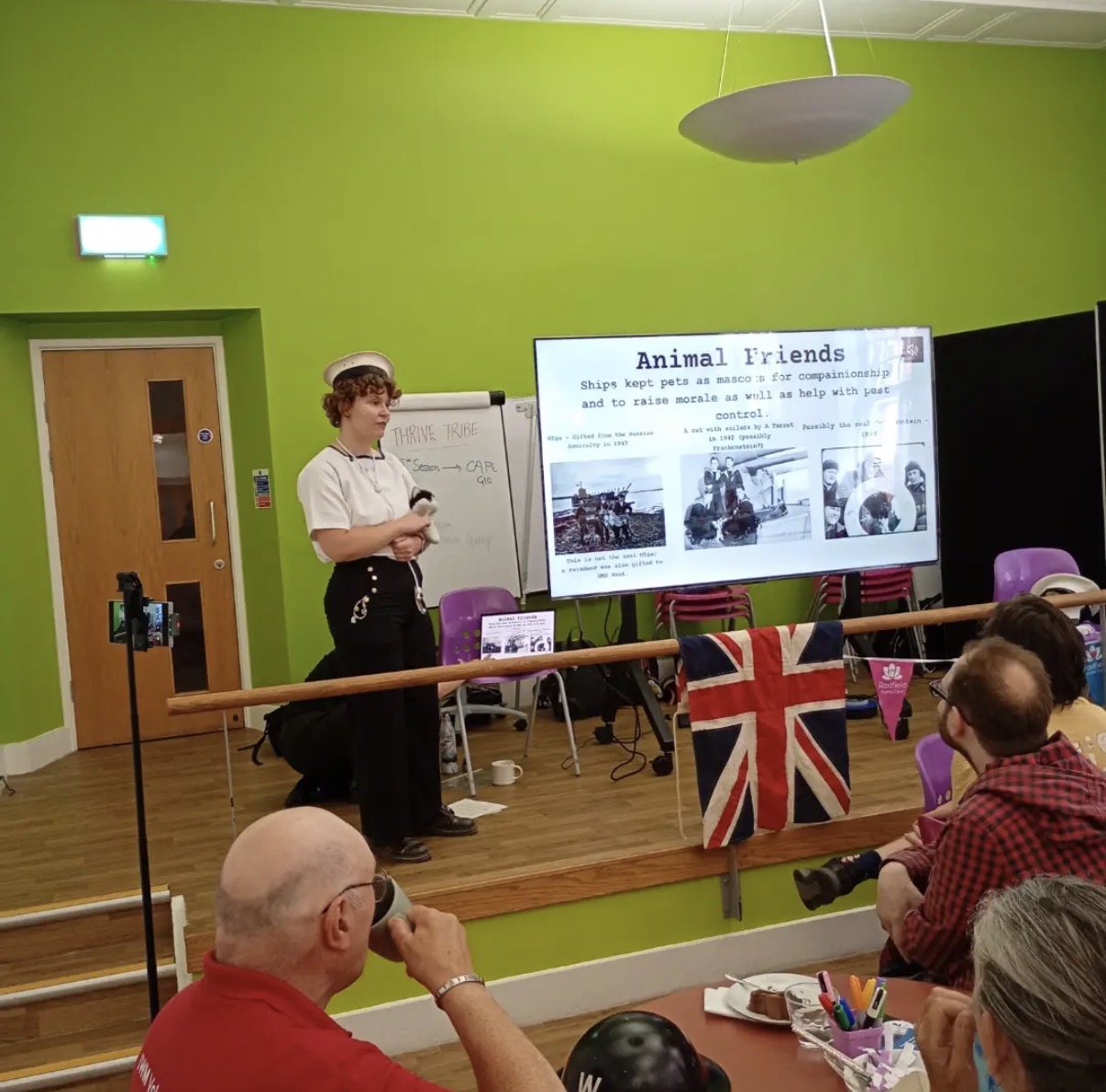
I am proud to share that I have completed and delivered my first EVER living history workshop outside of my autism group as a session lasting at least 20 minutes (which again, I would like to bring these workshops to the younger age groups as part of their programme) or a brief 10-15 minute festival act.
It all started as a new year's goal!
Finding opportunities to deliver living history and costumed interpretation workshops in communities was one of my top aspirations for this year; the idea hit me last year after visiting Portsmouth Historic Dockyard and meeting a costumed interpreter acting as Jackie Fisher (father of the Dreadnoughts and known for the first use of OMG) when he served on HMS Warrior as Lieutenant, then meeting the volunteers at the Mary Rose Museum who were in period costume, then the inspiration hit me - how about I bring costumed interpretation and living history into my volunteering?
I was lucky to have the honour of providing some wartime entertainment at my autism group for the 80th anniversary for VE Day (read here) as well as performing an act as a sailor at a music festival last July which you can read more about here, but I was just starting out with people I know and with organisations and charities I am involved with.
Last Christmas, when I received the last volunteer newsletter of the year from Imperial War Museums, a volunteer had delivered a workshop at a care home as a trial, then inviting more volunteers along to develop the project. It started out as a couple of meetings to introduce the project and develop ideas, whereby myself and fellow volunteers on the project were from IWM London and Churchill War Rooms, but sadly not a lot of interest from the HMS Belfast volunteers, so I took the King's Shilling and discussed producing my own workshop.
Change of Audience
In the first planning meeting, my original plan was to take it to my autism group where I could produce a visual timeline. Later, when sat in a coffee shop, as well as considering audience needs and attention spans, I thought why not make HMSB’s timeline a physical theatre sensory story?
What is a Sensory Story?
When I did a work experience placement with a local SEND school in their performing arts department, sessions included a ‘sensory story’ where there would be a specific theme, such as an enchanted forest, space, under the sea or a safari.
We would use tactile items like materials, silk scarves, parachutes, ribbons, bean bags (the handheld ones from primary school PE classes NOT the floor seating) and colourful, calm lighting, playing specific music matching the said theme, then comes the physical theatre side of it; posing as objects, movement, pretend play which may include props like hoops (again, a classic example of primary school PE equipment) and pretty much prancing around the studio.
So I drew up a mind map on my iPad:
I spent a lot of time in coffee shops planning and writing down my ideas - my whiteboard app was filled with minds maps, lists, ideas, as well as a brief timeline. I thought I would need to do a ton of shopping at Hobbycraft or any other arts and crafts provider for materials; either paper crafts with fancy art pens for a visual timeline or haberdashery materials for the sensory story, or perhaps bringing my Northern Lights projector (specifically, holographic shimmery satin or blue sequin mesh for the sea, crunchy foil for ice and my Northern Lights lamp for the Arctic Convoy and Battle of North Cape segment). For action station sequences, my idea for an alternative to 6-inch shells would be foam tennis balls or soft play balls so no one gets hurt!
Suddenly, an opportunity came up to deliver a workshop for my drama group Quest Soul Theatre's Connection's Cafe; a creative arts cafe taking place once a month, read more here.
With this in mind, I kindly offered to take my workshop there.
When I had the first meeting with Quest Soul and IWM to introduce each other, I brought up the idea of the sensory and physical theatre inspired by HMSB's timeline. That morning, there had been a Connections Cafe held whereby I noticed those who regularly attend may have mobility issues or would prefer not to be gallivanting around a space.
We agreed we should keep it simple and stick to a visual timeline in the form of a visual presentation, so I got to work!
If you're still not sure what is meant by physical theatre, an example of a play using physical theatre techniques is The Curious Incident of the Dog in the Nighttime performed by physical theatre company Frantic Assembly. Feel free to check out this BBC Bitesize page with a very useful explanation on physical theatre.
So there I was going through some physical material that either I own, (such as any books on HMSB) and I did consider visiting IWM's Research Room which I have done before to look at some physical objects that may inspire, as well as considering other collections; Royal Museums Greenwich's collection has photographs taken on HMSB pre-commissioning (view here) and a painted portrait of her last captain, Rear Admiral Morgan Morgan-Giles (pictured below under the Operation Seahorse section).
To keep things theatrical, I would have liked to include some audience participation and interaction (like in pantomime, immersive theatre or promenade theatre), but at the final briefing before the workshop, a fellow volunteer said it may not be ideal for our audience's needs as our session would be inclusive of those living with dementia and may not be receptive to it.
As well as my original ideas being to produce mock enlistment papers (then doing a Brecht's Mother Courage and demand they hand them to me as their Chief Petty Officer) for audiences to fill out and shouting out "Action Stations" when this audio played (I am now inspired to learn the bugle for future workshops and insight talks), the immersive pantomime-style audience participation would include HMSB's D-Day gunnery routine where I would split the audience into Port and Starboard and both teams would take turns to shout out each individual command in unison given when firing the guns, then together in unison, everybody will shout "FIRE" as the main command.
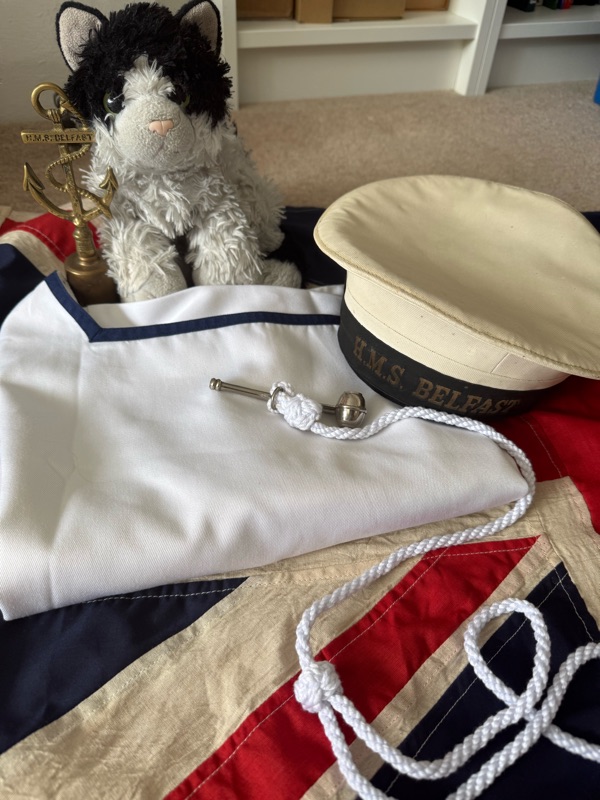
After making the agreed alterations to the presentation (which did include more coffee shop hopping), I was ready, apart from having little time to practice piping the 'still' and 'carry on', just to add to the theatrical side.
After a final mini-briefing with a volunteering officer for a final check and show them the alterations I made as recommended, then a few test runs for the bosun's call signals, I was ready to go!
Now this is the story of how I became a community theatre ambassador…
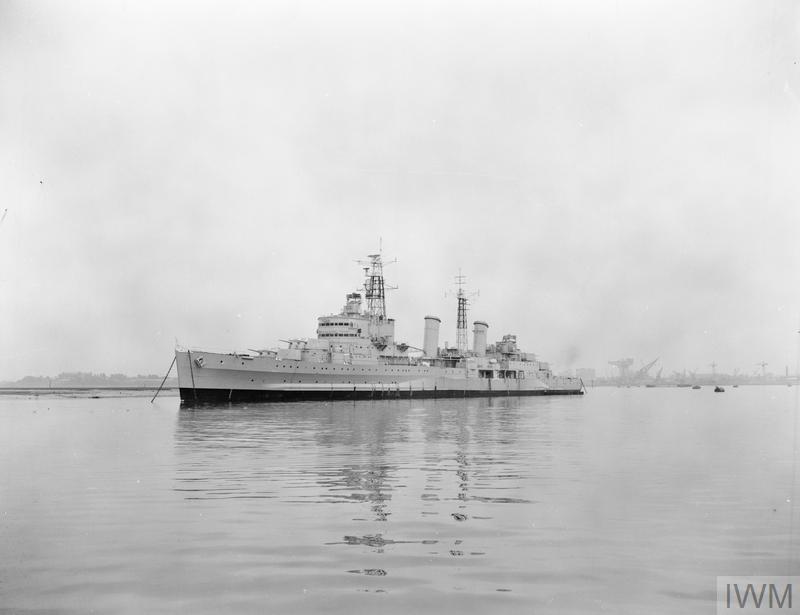
I began by introducing HMS Belfast as a physical journey throughout her naval career, including her physical and historical features, such as her main armament, the 6-inch gun turrets, her propulsion of admiralty 3-drum boilers and steam turbine propelling her to 32 knots, carrying 2 Supermarine Walrus biplanes (despite being a Town-class light cruiser, NOT an aircraft carrier) as well as being the sister ship of HMS Edinburgh that sunk after being hit by a sneaky U-boat with Russian gold bars on board worth £1.5 million at the time.
Next was her launching at Harland and Wolff Shipyard at Belfast (same company that built the Titanic), followed by the very start of her naval career from her commissioning, right into the capturing of the German passenger liner the SS Cap Norte (disguised as a neutral Swedish vessel), then the disastrous mining in the Firth of Forth putting her out of action for 3 years, then back in action for the Arctic Convoys, what Winston Churchill claimed to be "the worst journey in the world".
Heading home from the Russian port of Murmask came the Battle of North Cape, in other words, the sinking of the German battleship KMS Scharnhorst, which brings us to HMSB's biggest battle honour, the D-Day landings; where she was part of Bombardment Force E off the coast of Juno and Gold beaches, which includes her supporting the Canadian troops from Juno Beach and firing over 5,000 rounds of ammunition.
After spending the remainder of the Second World War supporting the allies to fight the Japanese, HMSB then served in the Korean War with the UN forces as part of a maritime blockade against communist North Korea and targeting enemy railway lines, communication systems, roads and military bases. A US Navy admiral was so impressed by the accuracy of her guns firing over 8,000 shells throughout the conflict, he called her "that straight shootin' ship" - I cannot tell if this alliteration is intentional or not! 😆
I had to address HMSB's Roll of Honour which includes Leading Steward Lau So from Hong Kong, who was the only crew member to be killed in action aboard the ship; he was fatally wounded by a North Korean shell that hit the ship. Leading stewards would oversee meals and meetings among senior officers.
(Side note - the other names on HMSB's Roll of Honour are people died ashore whilst serving on the ship. Lau So's name is at the very bottom under the names of the two serving Royal Marines. The top name is 2nd Class Painter Henry Stanton who died from injuries after the mining).
Lau So had a traditional RN funeral held on board the ship and was buried on an island off the coast of Korea, following Chinese custom to be buried on land. There is a photo of his funeral service being held on the ship, as well as a photo of his grave that are on display on the ship, but unfortunately IWM has not digitised the images for online viewing.
Late last year, Lau So's grandson, Lawrence Fong came to visit the ship with his family and made a remarkable discovery! IWM researchers later confirmed that it was indeed Fong’s grandfather that served on the ship. Lau So's daughter (Fong’s mother) was very young when he was killed. Click here to learn more.
Then came her last commission of global peacekeeping exercises and collaboration with other international navies as a symbol of diplomacy; helping to build bridges from the consequences of conflict, explore historic landmarks and markets, honouring cultural differences as well as aid in the recovery and resilience from previous conflicts. Next, sadly came HMSB's decomissioning, where she was anchored in Fareham Creek in Portsmouth as an accommodation ship for the Royal Naval Volunteer Reserve; awaiting her fate of the scrapyard.
In 1967, Imperial War Museum began acquiring a naval object for their collection and were looking at preserving HMS Belfast, so this led to...
Operation Seahorse
The HMS Belfast trust was set up with IWM, headed by her last captain, Rear Admiral Sir Morgan Morgan-Giles (pictured below at the rank of Commander), who was also serving as an MP for Winchester. After fighting passionately for HMSB's case after the government refused to preserve her, the case was finally won in a late-night parliamentary debate, which then Belfast was towed from Portsmouth, to the Pool of London (the area of the Thames near the Tower of London and Tower Bridge, where the wharves once stood), her new permanent home!
I linked the below video to a QR code that went into a handout I made which sadly did not get printed, as well as being presented by Rear Admiral Morgan Morgan-Giles (yes, Morgan was his first name as well as the first part of his double-barrelled surname).
This story of Operation Seahorse is beautifully emotive - do excuse me while I grab a whole tub of ice cream and sob!! 🍨
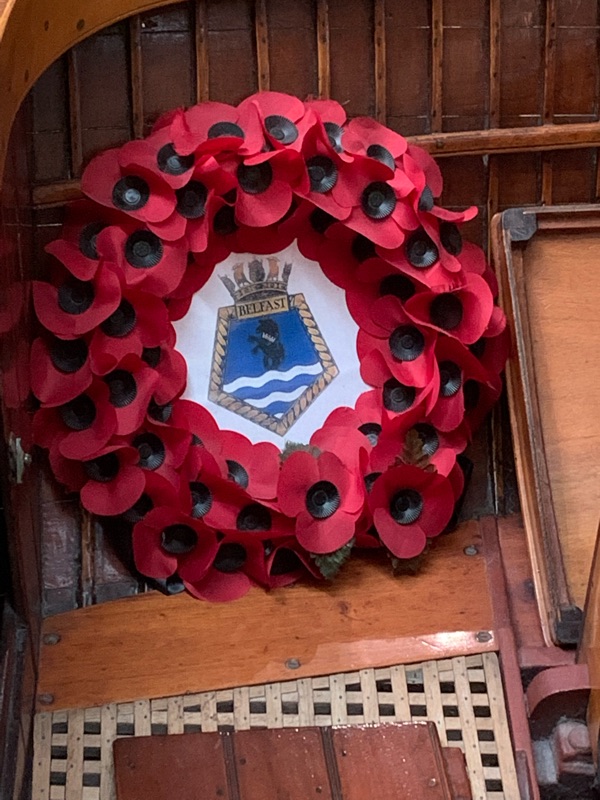
I discovered some HMSB poppy wreaths in a little boat at the National Maritime Museum Cornwall in Falmouth when I visited in October 2021 (around Trafalgar Day, as well as 50 years since becoming a museum), where I tried to find out more on a recent visit; I asked staff and volunteers if they knew anything, but sadly no answer.
I then began to research more on Morgan-Giles to aid my presentation for the last commission and Operation Seahorse segment; there I learnt the Morgan-Giles family were yacht and boat builders, which inspired Morgan-Giles himself to join the Royal Navy. They sadly are no longer in business and only operate an archive that offers registry of vessels. Find out more the about Morgan-Giles Archive here.
The boat on display at Falmouth was built at the Morgan-Giles shipyard, which clearly explains the connection with HMSB, as well as the said boat being Pip Emma; she is ADORABLE!!! 🥰 Don't you just want to scoop her up? 😍
This brings us to 21st October 1971 (Trafalgar Day) where HMS Belfast is officially opened to the public and given special permission to fly the white ensign despite being decommissioned. Since HMSB being towed from Portsmouth and opening on Trafalgar Day, HMSB was the second RN ship to become a museum since HMS Victory, the flagship of Vice Admiral Lord Horatio Nelson. With her grand opening as a museum ship on Trafalgar Day 1971, HMS Victory kept a watchful eye and was Belfast's guardian angel. Read my Trafalgar Day blog here - HMS Belfast shows the flags of Nelson's signal every Trafalgar Day.
Finally in 1978, Imperial War Museum gained full custody of HMS Belfast; since then she has been towed to Tilbury in 1982 for work on her propellers, then again in 1999, she was towed back to Portsmouth for full conservation work.
From 2002, HMS Belfast has hosted Kip in a Shipsleepovers for scout groups, schools and youth groups as part of their learning program, as well as still serving as a training vessel to City of London Sea Cadets that meet on board twice a week.
I finished by raising a toast Royal Navy style (with whatever drink my audience had as I would NOT be allowed to play rum bosun by handing out a tot of rum and call an "up spirits") to HMS Belfast, her battle honours, naval career and a living memorial for future generations. 🍻
The full presentation is videoed below, so please feel free to watch! I apologise in advance for my West Country accent delivering a line from a shipwright from Devonport DESPITE the fact I had practised it!! (I sadly was never taught accents in drama school)!!
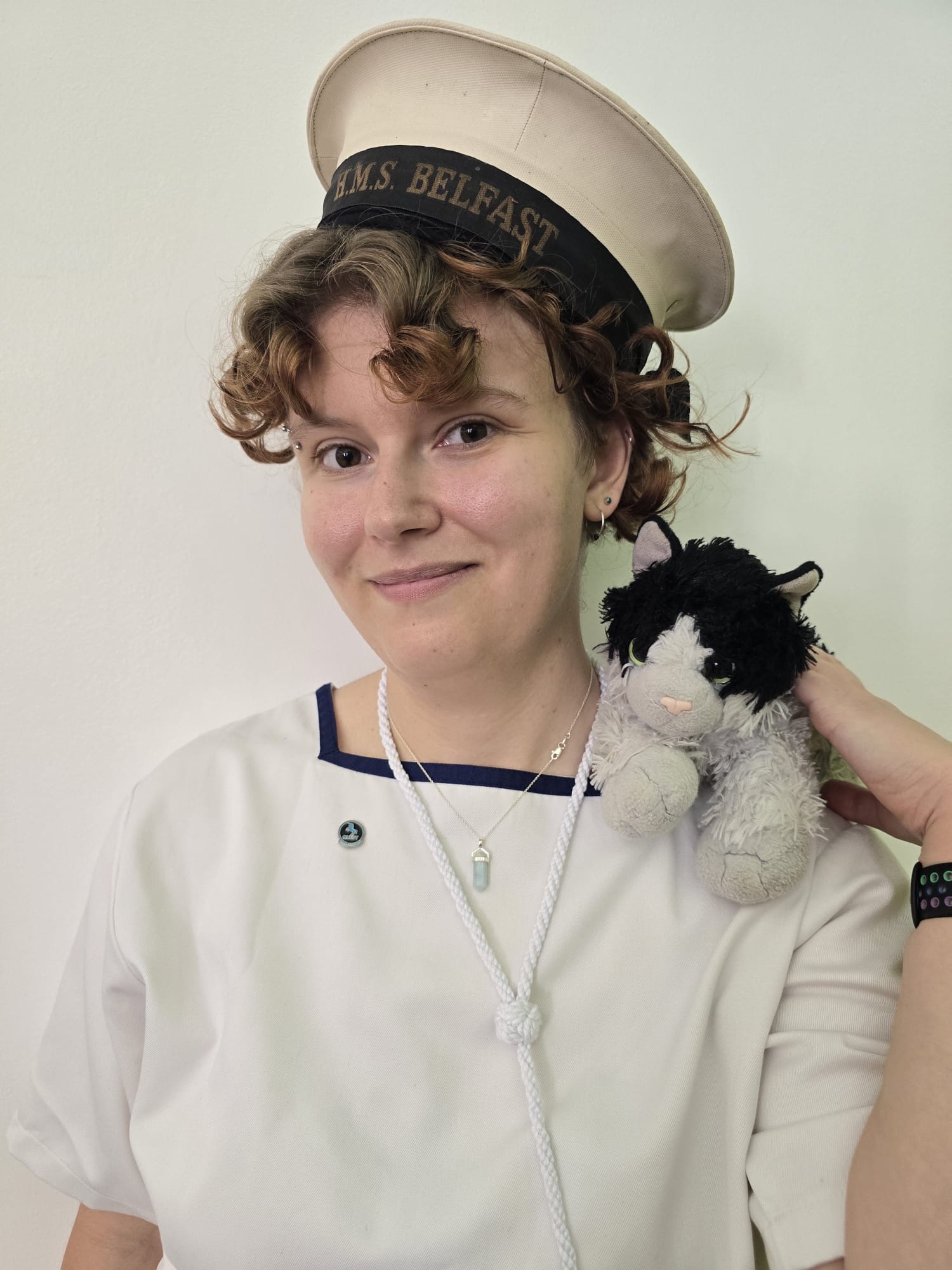
Frankenstein, the ship's cat, was a great help to me too; it was great to have him as a puppet figure with the theatrical side of things. I cannot wait to share more about Operation Chief Mouser, which I will write more about in another post. I fantasise that we are just like Sabrina and Salem. 🐈⬛🐾
Pictured below is a film still from the IWM film archive; Frankenstein is believed to be the tuxedo cat, as interpreted through the toy in the hammock in the Arctic Mess Deck (he had his own hammock made specially for him by the sailmaker), the toy in the potato store (possibly his favourite place to hide and catch mice and rats) and the plushies sold in the gift shop.
IWM's photography collection also believed Frankenstein to be a tabby cat, like in this picture below; older additions of the IWM HMS Belfast guidebook claims the ship had 3 cats serving on board, so Frankenstein could have been any of these cats.
In the 1950's (possibly during the Korean War?) HMSB had a cat named Tojo, named after HMSB's connection with Japan (pictured below).
Tiger the dog was HMSB's mascot also in the early 1950's (possibly during the Korean War) - scanned from the HMS Belfast Pocket Manual.
Jenny the cat, who served as chief mouser in 1997 on the ship that became very frightened after a fox had gotten onto the ship via the gangway.
Trigger Warning: Pet Loss and Animal Abuse
I also got to introduce HMSB's other mascots; Olga the reindeer, who was gifted by the Russian Admiralty in 1943 as a mark of diplomacy during the Arctic convoys. Olga the reindeer was kept in the hangar where the Supermarine Walrus biplane was once stored after being removed in HMSB's 1942 refit. During the Battle of North Cape, Olga became very frightened and distressed by the noise that she could not be calmed, so she had to be put to sleep.
Captain Ellison (served July 1946-October 1947) had a pet mongoose who mysteriously disappeared somewhere on the ship when a terrible smell spread throughout the ship and the crew had to search for a dead mongoose.
Lastly, there were two cats adopted from Battersea in 2007, Oscar and Kilo, their story is very sad; Oscar went missing from the ship and never returned. Kilo suffered a tragic ending where a teenage girl went had been out drinking, then picked him up off the gangway and threw him into the Thames. The girl was arrested and sentenced to 6 months in prison for murdering a cat. HMSB has not had any mascots since.
Bravo Zulu! 🇬🇧
I would like to give my deepest gratitude to Quest Soul Theatre and Radfield Home Care for providing this wonderful opportunity, I would be most delighted to do another workshop with them. I am very lucky to be given the honour of being one of Quest Soul Theatre’s ambassadors as a mark of their gratitude for my contribution. 🏅
During a gym workout session when taking a brisk walk on the treadmill, I received a WhatApp message from my father saying his colleague is doing a research project on an abandoned RAF and US Army Air Force (USSAF) airfield in Essex, and is inviting me along on the project. I met with my father's colleague soon after; he explained the history of the airfield on how it was one of the airfield for the Americans during Britain's alliance during the Second World War, then the RAF came in later. Despite being operational for only two years, the airfield also played a part on D-Day with the Glider Pilot Regiment, then onto Operation Market Garden (Battle of Arnhem), followed by the Rhine Crossing (Operation Varsity). A month later after holidaying and day trips, I booked myself into Imperial War Museum's research facility and requested to look at Bruce Stait's book, Rivenhall: An Essex Airfield and some documents to see what I could learn about the airfield. I then bought ...
It's a big year for Trafalgar Day - 2025 marks 220 years since this epic moment in naval history. You’re probably wondering: what does HMS Belfast have to do with Trafalgar Day? The straight answer is, there is no direct connection between her and HMS Victory, which despite being a museum ship (which is what they have in common) in Lord Nelson’s memory and being permanently dry docked, is still in commission with the Royal Navy for over 200 years. 21st October 1805 The Royal Navy, commanded by Vice Admiral Lord Horatio Nelson aboard his flagship, HMS Victory, literally broke the mighty line made up of the combined fleet of the French and Spanish navies. This was the Royal Navy’s greatest achievement in history, but sadly as King George III claimed, we had lost more than we had gained; although a great victory had been won, the story includes the tragic loss of Lord Nelson, after being shot by a French sniper. 21st October is a special occasion for the Royal Navy because that day, i...
I stepped out of Portsmouth Harbour train station one freezing cold Saturday afternoon in January this year. I was slowly making my way to my hotel and stopped to admire how beautiful HMS Warrior looked against the winter sunset over the harbour, so I sat down on a bench to bring myself out of anxiety about getting lost, shutting down or dissociating and losing awareness of my surroundings and into the present. After a moment, I noticed an obelisk with HMS Royal Oak inscribed on it; I quickly learnt it was a memorial commemorating the 85th anniversary of the sinking of HMS Royal Oak. I knew I had to take some photos for some volunteering. (This memorial will be discussed in a future post - watch this space!) 😀 The reason I was visiting Portsmouth was because I am a board member at the National Museum of the Royal Navy and our board was encouraged to visit for branding reasons. After spending a couple of hours chilling in my hotel room by video-calling family to let them know ...





Comments
Post a Comment