RAF Rivenhall Research

During a gym workout session when taking a brisk walk on the treadmill, I received a WhatApp message from my father saying his colleague is doing a research project on an abandoned RAF and US Army Air Force (USSAF) airfield in Essex, and is inviting me along on the project.  

I met with my father's colleague soon after; he explained the history of the airfield on how it was one of the airfield for the Americans during Britain's alliance during the Second World War, then the RAF came in later. Despite being operational for only two years, the airfield also played a part on D-Day with the Glider Pilot Regiment, then onto Operation Market Garden (Battle of Arnhem), followed by the Rhine Crossing (Operation Varsity). 

A month later after holidaying and day trips, I booked myself into Imperial War Museum's research facility and requested to look at Bruce Stait's book, Rivenhall: An Essex Airfield and some documents to see what I could learn about the airfield. I then bought my own copy of the book so I don't have to rely on IWM's copy nor wait until my next visit to use the research room. 
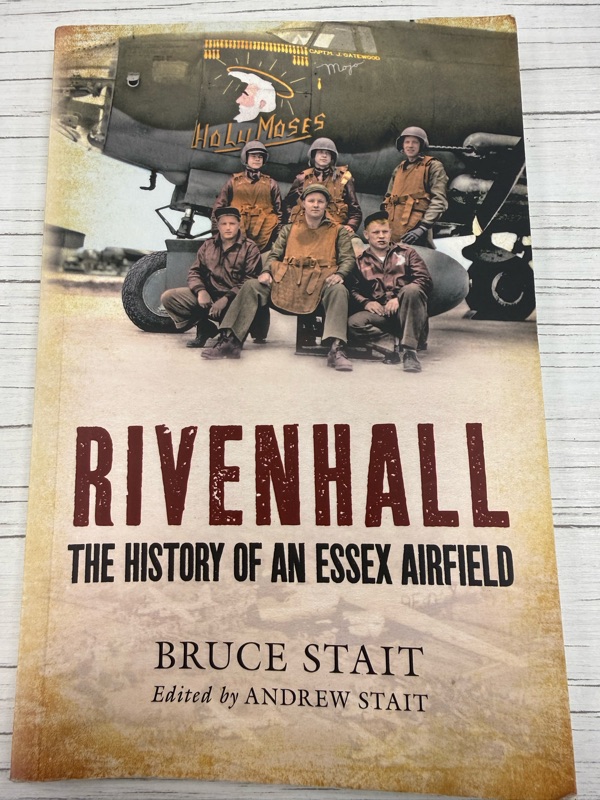

Rivenhall: The History of an Essex Airfield by Bruce Stait was such an informative source to begin with; it has different chapters on the different points on its historic timeline from the construction of the airfield to the American Fighter Group to the RAF Horsa gliders taking part in Operation Varisty (the crossing of the River Rhine).   

Contruction of the airfield began in early 1943 by US Army Engineer Battalions. Rivenhall was one of the fifteen airfields in Essex and airfields for the Americans were mainly in East Anglia (mainly in the northern part of Essex).  
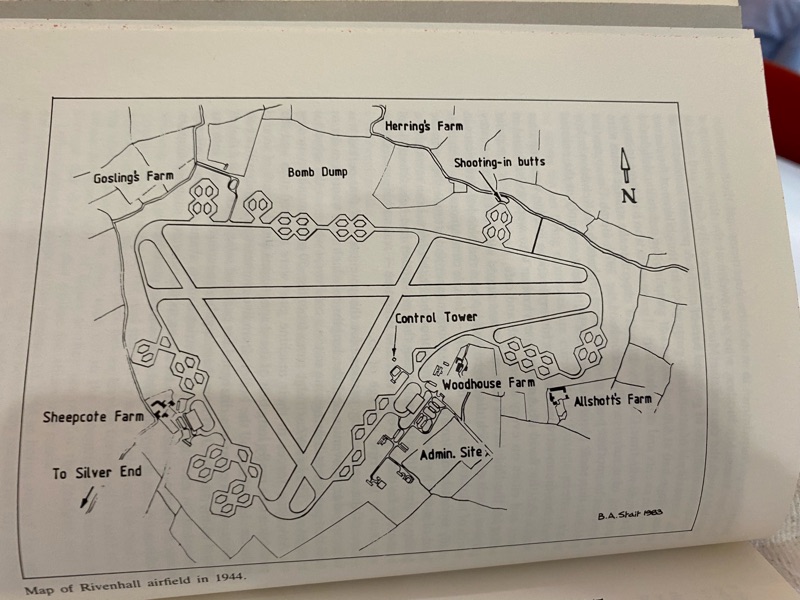

With immediate internet resources, I found lots of aerial images of the airfield, exactly as the 'bird's eye view' itself as interpreted in the book. 


I spent a good bit of time searching for a clearly labelled map after coming across a lot of aerial shots and recent drone photography, I would love to find a map that would show where other facilities were, for example, the cinema, gymnasium or medical unit.  

Image Credit: Wikipedia


Features of RAF Rivenhall/USSAF Station 168

  • 3 runways (one measuring 2,000 yards and the other two measuring 1,400 yards)
  • 2x T2 hangars
  • Nissen huts
  • Sick quarters
  • Mess halls
  • Cinema
  • Firing range
  • Armouries 
  • Workshops
  • Quartermasters store
  • Petrol storage
  • Control tower 
  • Bomb dump (north side)
  • Living and working spaces (south side) 

With the site of the airfield built on Woodhouse Farm, covering 270 acres, was then reduced to 50 acres, in a naturally abundant area for gravel, thousands of cubic yards from Silver End gravel pit which later became a swimming hole (and death trap for non-swimmers!). 

USSAF Station 168

Rivenhall Airfield was home to the United States Army Air Force (USSAF) Station 168, starting with the 363rd Fighter Group, commanded by Colonel John R. Ulricson of the US 9th Air Force. Station 168 (originally in the US) began its move to Rivenhall in January 1944, crossing the Atlantic on the RMS Queen Elizabeth, which was completed by the 4th February. 

The 363rd Fighter Group was the 3rd Mustang group formed in England and was made up of 3 squadrons; 380, 381 and 382. As of January 24th 1944, they unfortunately had a shortage of aircraft, consisting of 11 P.51B Mustangs for supply to the RAF. The P.51A had a liquid cooled engine, whereas for all Mustangs, the P.51 engines were replaced with Rolls Royce Merlin engines (same engine as a spitfire - which is why I call Mustangs 'American spitfires'!), which improved the Mustang's performance. Manufacturing of the P.51B Mustang increased during the last 18 months of the Second World War; P.51B's had bubble cockpits, and the P.51D did not arrive until May 1944. 

363 Fighter Group's Mustangs were olive green with a grey undercarriage. By the time the group left Rivenhall, depending on the squadron, each Mustang would have a coloured nose:

380 Sqdn. (coded A9) - BLUE

381 Sqdn. (coded B3) - YELLOW

382 Sqdn. (coded C3) - RED

The 363 Fighter Group would escort B-17 fortresses to major operations such as The Big Week (Operation Argument), whereby a total of 3,300 bomber sorties were flown to carry out a major air raid on German aircraft factories, engine production units and ball-bearing plants - preventing the Luftwaffe launching more aircraft into the sky which would soon be shot down by allied escort groups, followed by the D-Day Landings; by then, the USSAF had left Rivenhall and was then occupied by the RAF 295 Squadron 
and the Glider Pilot Regiment. 

RAF 295 and 570 Squadrons 

Best way to tell them apart: 

295 Sqdn - Short Stirling aircraft 'Help from the Skies'
570 Sqdn. - Horsa Glider aircraft 'We Launch the Spearhead' 

Both of these squadrons flew to their new base at Rivenhall from RAF Harwell in Oxfordshire on 1st October 1944, with the operation complete on the 7th October. The Short Stirling Mark IV's of 295 Squadron would tow the Horsa Gliders of 570 Squadron; together being part of the RAF's No.38 Group. 

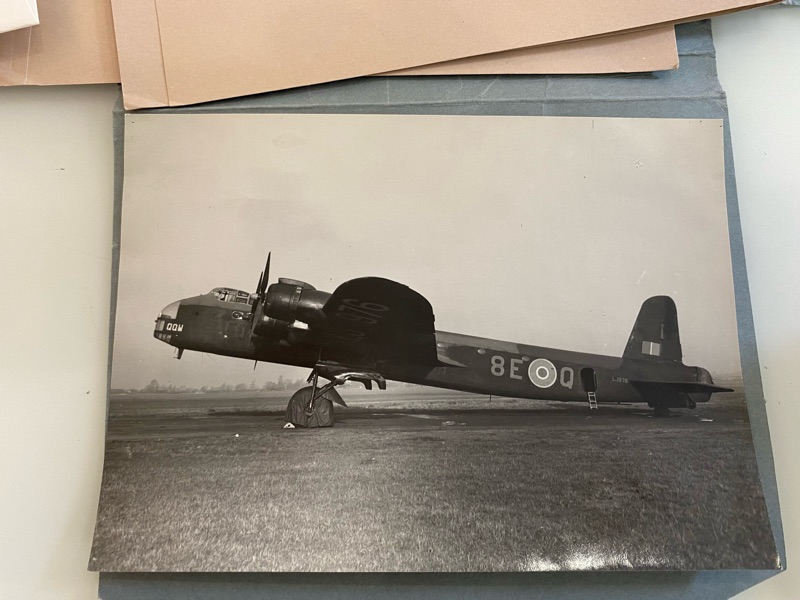
295 was coded 8Z for 'A' flight with their propeller bosses painted red, and 8E for 'B' flight that had yellow propeller bosses. 570 were coded with E7 and U8. 

570 Squadron formed in 1943, the same year that Rivenhall Airfield opened and were occupied by the USAAF; crews from 295 Squadron were transferred to 570, with the Stirlings and Horsa's camouflaged in the RAF night bombing colour scheme (dark green and dark earth above and matte black undersides). 

The RAF serving personnel were made up of the following: 

  • 251 officers
  • 603 NCO's (non-commissioned officers; an example would be a flight sergeant in the RAF - equivalent to an army sergeant or a naval petty officer).
  • 1,838 other ranks 
  • 300 WAAF personnel (Women's Auxiliary Air Force) - the WAAF quarters were housed on the north-east perimeter of the airfield in Storey's Wood.  

RAF personnel flying to Rivenhall flew in the aircraft they serviced; for the majority of them, it was their first time flying. Bruce Stait writes that a glider instrument technician described the transition from Harwell to Rivenhall as 'precisely organised and well disciplined... the lads were able to take personal kit, toolboxes and bicycles with them...'  - exciting times!! 

The radio telecommunication call sign for Rivenhall's control tower was 'snuggle', with the call sign for 295 Squadron being 'icepack'. 


Glider Pilot Regiment

The Glider Pilot Regiment was a unit of the British Army that were flown by pilots and carried paratroopers coming from the Army Air Force, The Parachute Regiment or the SAS, as well as weapons and supplies; yet the training, towing and home bases were provided by the RAF. 

Why were the gliders towed? They have no engines! This does explain the book title Wot! No Engines? by Alan Cooper about the glider's role in Operation Varsity, as well as information on how gliders work and what they're made of, which they'll all be made from plywood and chicken wire. A glider wouldn't take off itself, because they did not have engines, so the Short Stirlings would tow them with a rubber bungee cord to get them up, then the glider would land itself by descending, and when landing, it tilts down diagonally onto the nose wheel, then rock up, and the brakes would be applied. 

Longer runways were provided for gliders due to the impact on landing, whereby those trainee pilots at Rivenhall would sometimes end up off the runway, outside the airfield, or with parts damaged or missing. 

There is more about gliders in this video by the De Havilland Museum:

Not all of Rivenhall's gilder pilots were volunteers; in fact, a lack of volunteers was due to heavy losses from Arnhem (Operation Market Garden), so RAF pilots would have ended up on secondment with the Glider Pilot Regiment. 

Training exercises were devised for tug and glider crews to give further experience and for learning to manoeuvre, which would also include being towed in the air for a further 3 hours, then releasing the tow for a 1 hour cross-country flight for the glider crews. 

Bad weather would affect the training exercises; an exercise taking place on the 29th October 1944 was disrupted by rain and low cloud levels. 

Crossing the Rhine

Both Rivenhall squadrons of No.38 and No.36 groups took part in Operation Varsity; the final major operation of the war.

On Saturday 24th March 1945 - with the allied troops on ground, the paratroopers and gliders from the American 17th and British 6th Airborne Divisions landed on the east bank of the Rhine near the town of Wesel, on the German/Dutch border. 

On the eve of Varsity - the airfield was sealed off; no one could leave, send mail or make telephone calls. An airman of Rivenhall, who helped construct the airfield, was unloading bombs onto a lorry to take back to the airfield from a railway siding in the nearby town of Kelvedon recalled how the airfield was bordered with barbed wire so no one could get in or out, as well as keeping Operation Varsity a secret. “One Sunday Afternoon when I returned from such a trip as I found the camp was sealed off and barbed wire was everywhere… This was the eve of Operation Varsity - one of the worst kept secrets of the war. It was certainly common knowledge in our local hostelry, The White Hart in Kelvedon.” Turns out that the operation wasn’t such a secret after all and would be brought up in conversation at a local pub. 

The glider pilots, aircrews and airborne troops were carefully briefed. At 2am (on the morning of the 24th March), all personnel involved had a last briefing (including final weather reports), then the Stirlings marshalled along the perimeter runway with gliders loaded with troops and equipment parked at the end. 

The Stirlings taxied into position with their 244 Hercules engines giving a deafening roar, and gliders lined up to be connected to the Stirling's tow lines, then a take off signal was given by the control officer, one by one at 7am. One take off was sluggish - a glider left the ground first for 30 seconds, then the Stirling took off 3 seconds after. A total of 61 Stirlings towed 60 Horsas from Rivenhall en route to the Rhine (one Stirling carried press observers). Three tow ropes broke, which meant the spare tugs were called up and caused delays in take offs. 

Sgt Tony Wadley, an RAF pilot who seconded to the Glider Pilot Regiment in autumn 1944 as second pilot to Sgt 'Tug' Wilson, he recalls: 'Each glider crew received a low-level landing zone at the briefing, close to a farm house near the German town of Hamminkeln, which used to be Divisional HQ. We were woke really early.. with tea brought to our hut by WAAF cookhouse staff. Our Horsa was loaded with a Jeep and trailer carrying radio equipment together with 5 troopers from the Devon regiment. Take-off was soon after seven o'clock... our tow rope broke before we were airborne... We finally took off 8.55 a.m. long after the remainder of the Rivenhall serials had departed." 

The squadrons then rendezvoused with another squadron from Hawkinge in Kent, which a lot of airmen claimed to be a relief for airsickness, then they took off again to continue their 4-hour flight to the Rhine. 

The whole convoy was made up of the following:

  • 1,696 transport planes (commonly Short Stirlings)
  • 1,348 gliders (some in double tow)
  • 21,680 troops (transported via gliders)
  • 889 fighters (acting as escort)
A further 2,153 aircraft were given the task of attacking enemy defence in target areas or ranging far into Germany to stop the Luftwaffe from attacking the Allied landings. Airfields, bridges, marshalling yards and other easy targets; 2,596 heavy bombers and 821 medium bombers from the Allies attacked these targets to break German morale during the Varsity mission, even the sound of engines roaring from Allied air superiority felt welcoming to troops on the ground at the Rhine (although still the same mission, the land operation was known as Operation PLUNDER - VARSITY was the air operation). 

The Rivenhall squadrons had the honour of leading the airborne fleet over the Rhine at Wesel; both living up to their mottos: 'We Launch the Spearhead' (570) and 'Help from the Skies' (295). The gliders and paratroopers descended through a dust and smoke blown by a westerly wind across the target landing zones and within range of anti-aircraft fire and small-arms fire. British glider landings were somewhat accurate - within 20-30 yards of their target. 

This did not mean that the landings would not be without incident; fortunately, the casualty numbers were rather light, despite the majority of gliders being damaged. 

Glider Pilot Regiment Casualties:


  • Dead - 38
  • Wounded - 37
  • Missing - 135


Several aircraft were hit with light flak; one 295 Sqdn Stirling pilot in particular, W/O Symons, 8E-J, had his Stirlings port inner hit and set on fire. He managed to keep flying while the rest of the crew escaped, but it was too late for him; he was killed by striking the tow hook, which then the aircraft crashed in flames. Two of his surviving crew reported back to Rivenhall a few days later.

Wadley remembers: "The only incident I recall was the sight of a Horsa a little to our right breaking its tow over the North Sea; the Air Sea Rescue boys no doubt speedily picked them up." Wadley was able to return to the RAF and kept serving until the end of the war; he resigned in 1950. 


300 gliders were seriously damaged, with 10 being shot down; among them was towed by B-Beer, one of the first to cross the Rhine. When the Stirlings that had dropped off the gliders at the Rhine dropping zones returned after a 5 hour flight back to Rivenhall by lunchtime that day, it was reported during a debrief that they witnessed the launch of a V2 rocket when flying over Germany leaving a smoke trail behind it. 

The returned crews were then briefed of a potential re-supply dropping back at the Rhine for the Allied troops, but no sorties were flown and crews were eventually stood down.  


SIDE NOTE: I am not affiliated with Bruce Stait, but if you would like your own copy of Bruce Stait's book, you can purchase it on Amazon here.

L.A.C Brian Poole 


Brian Poole was born on 23rd June 1923 in Northwich, Cheshire. During World War 2, he was called up for national service on his 18th birthday, where he joined the RAF. 

Poole trained at RAF Bridlington and then transferred to RAF Crosby; he wanted to be an instrument maker, but a lack of vacancies led him to train as an electrician, and later a radio operator. He temporarily served in the Service Police, then trained as an instrument repairer at RAF Melksham, where he was promoted to an A.C.1 (aircraftman 1st class). 

He was transferred to other RAF stations, such as Castle Bromwich in September 1942, then in November 1942, he was based at Netheravon and Hurn. Poole became a L.A.C (leading aircraftman) before he was on deployment in North Africa; spending five months in Morocco, Algeria and Tunisia. 

In October 1944, Poole was transferred to RAF Rivenhall where he served for 16 months. Throughout his RAF career, he had a pen pal called Trudie Lach (possibly pictured in the left hand corner of his portrait photo) from Florida, USA, who he would write to on a regular basis; including birthdays, Christmas and other public holidays. 

First Letter to Trudie Lach: 
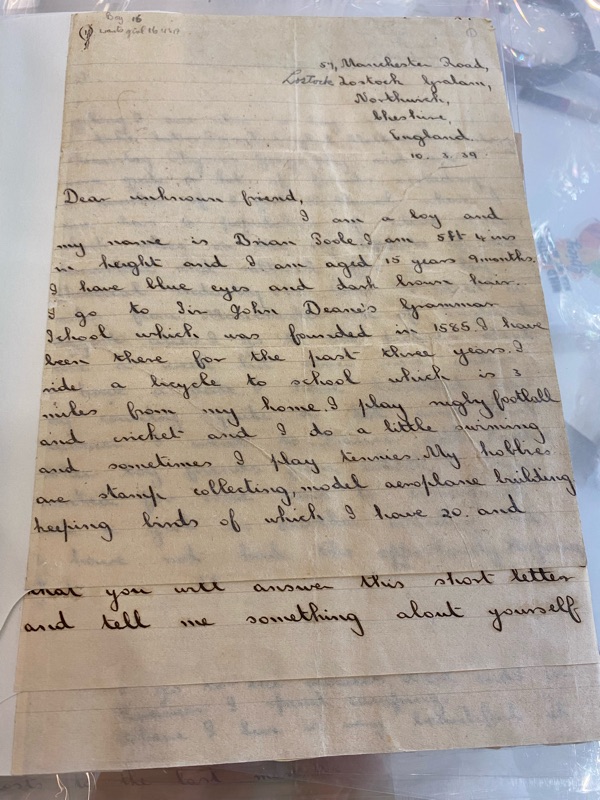
Poole's first letter to Lach was written on 10th March 1939, before he joined the RAF and months before war was declared; Brian Poole was still a schoolboy when this was written - ( I was trying to interpret whether it was the American date: MM/DD/YYY or the British date: DD/MM/YYYY)! 😂
Cursive handwriting can be quite difficult to read, but I will try my best to interpret it. 😉

Letter reads:

Dear unknown friend,

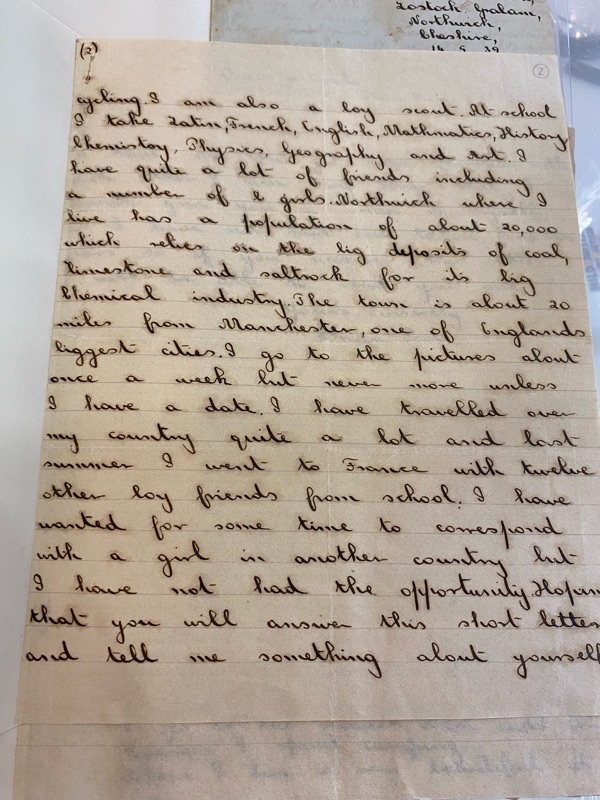
I am a boy and my name is Brian Poole. I am 5 ft 4 ins in height and I am aged 15 years 9 months.
I have blue eyes and dark brown hair. I go to Sir John Deane's Grammar School which was founded in 1585. I have been there for the past three years. I ride a bicycle to school which is 3 miles from my home. I play rugby, football and cricket and I do a little swimming and sometimes I play tennis. My hobbies are stamp collecting, model aeroplane building, keeping birds of which I have 20, and cycling. I am also a boy scout.

At school, I take Latin, French, English, Mathematics, History, Chemistry, Physics, Geography and Art. I have quite a lot of friends including a number of girls. Northwich where I live has a population of about 20,000 which relies on the big deposits of coal, limestone and saltrock for its big chemical industry. The town is about 20 miles from Manchester, one of England's biggest cities.

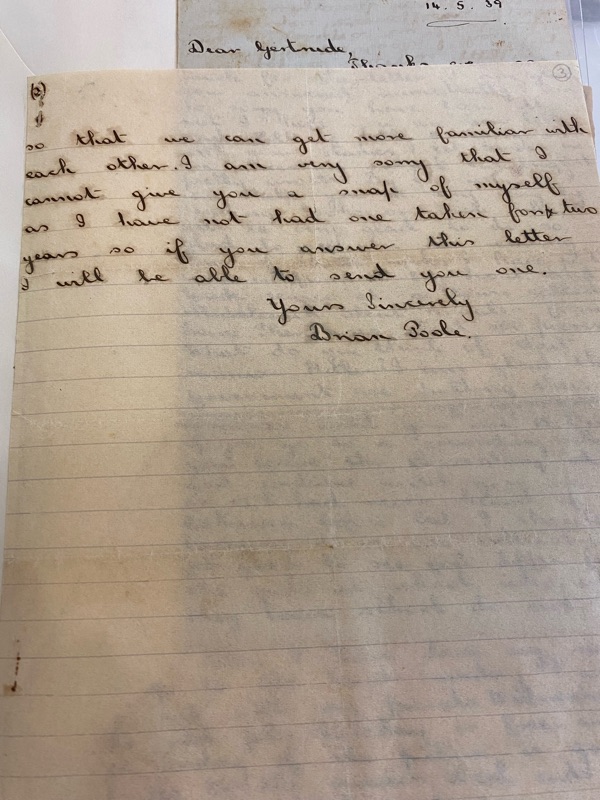
I go to the pictures about once a week but never more unless I have a date. I have travelled over my country quite a lot and last summer I went to France twelve other boy friends from school. I have wanted for some time to correspond with a girl from another country, but I have not had the opportunity . 

Hoping that you will answer this short letter and tell me something about yourself, so that we can get more familiar with each other. I am very sorry that I cannot give you a snap of myself as I have not had one taken for two years, so if you answer this letter, I will be able to send you one. 

Yours sincerely,

Brian Poole

Trudie Lach of course, did indeed reply and kept in contact with each other throughout the war, including when he joined up with the RAF. His portrait (pictured above before the letter) looks very handsome, donning the looks of a stereotypical RAF pilot. 

They even exchanged photos with each other, including photos of themselves, greeting cards and newspaper clippings. 

Letters written from Poole to Lach while he was based at Rivenhall were dated between October 1944-April 1945; in the letters from this segment, there was no word of him being involved with Operation Varsity while posted at Rivenhall. Considering that prior to Varsity, the airfield was sealed off so no communication could be made whatsoever, which could explain why. 

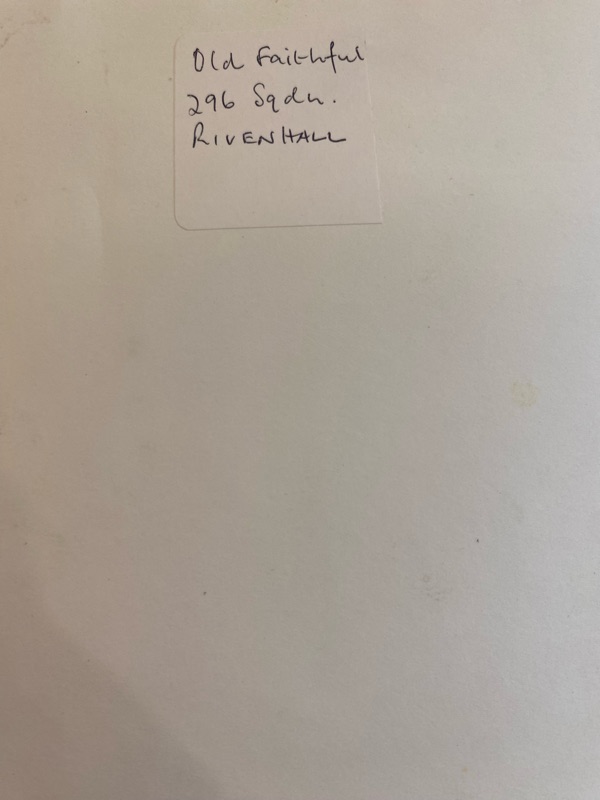
It may have been likely Poole was part of 295 Sqdn. His post before Rivenhall was RAF Harwell in Oxfordshire; his file of private papers where I read these letters had a photo of a Stirling, whereby the label had a mini description reading: 'Old Faithful' [name of Stirling] 296 Sqdn. RIVENHALL. This may have been the Stirling that he worked on as a leading aircraftman, or that he flew from Harwell to Rivenhall in that said Stirling. 


You can see these letters if you book to visit the research room at Imperial War Museum; the Rivenhall letters are from Volume 4 (which you might want to add into any notes or special requests when you book your slot). The Stirling photo is in wither Volume 4 or 5. 

Find out more about the IWM Research Room by visiting the research page on the website and learn more about the private papers of B. Poole here. 

Rhoda Robinson

Rhoda Robinson volunteered to join the American Red Cross during WW2 as a Staff Assistant, trained in Washington D.C. and came to England in February 1943. When she arrived in England, she was assigned to Alconbury (Station 102). Within a week, she set up the GI's Aeroclub, where serving personnel can relax and play outside off-duty in a former British NAAFI Canteen (Navy, Army and Air Force Institute). 

She was promoted to club director in August 1943; highlights included a visit from Nelda Kurtz (the real Rosie the Riveter), hosting a children's Christmas party and His Majesty King George VI and Queen Elizabeth coming for tea in February 1944. 

Robinson was later assigned to Rivenhall, and then onto Hardwick (Station 104), before her final posting to Headquarters as supervisor, located at Prince's Gate. She returned to America on 15th November 1945 aboard the Queen Mary, where she was remained friends with those she met in Britain ever since. 

Find out more about Rhoda Robinson here, where her American Red Cross cap is on display at the American Air Museum at IWM Duxford. Robinson was one of the serving personnel at Rivenhall under the USAAF - which explains her club name being 'GI' (American soldier) Aerospace (aviation). 

Interview with John Cretchley May 

John Cretchley was the 2nd pilot of a Stirling based at Rivenhall who took part in Operation Market Garden. There is not enough mention on whether he took part in Operation Varsity, but his has vivid memories of towing the gliders to Arnhem to deliver supplies and supporting the Norwegian Resistance by carrying ammunition in two groups from Rivenhall, despite the treacherous weather of rain, ice and snow, along with communications being affected; even his Stirling’s controls and joystick were frozen.

He recalls the new batch of pilots being recruited for Operation Varsity who did serve the mission.

If you would like to listen to the full interview on IWM’s online collection, click here.

My research for RAF Rivenhall continues. 

I am very excited to learn more about this former Second World War airfield. Maybe I will visit places of interest and heritage centres related to Rivenhall nearby. An incineration company INDAVER is currently based on its original site and have kindly agreed for a museum or visitor centre to be built in the area. All there is to do is carry on exploring! 

Comments

Popular posts from this blog

Introduction

Volunteers Week 2025

Portsmouth Historic Dockyard Visit - January 2025